Why Dogs Can’t Resist Ripping Paper (And When It’s a Problem)
There are ways to curb this curious temptation.
There are ways to curb this curious temptation.
by Mia Nguyen, CPDT-KA, FFCP, | December 18, 2025

Kashaeva Irina / Shutterstock
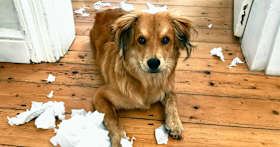
Many dogs have an uncanny talent for turning everyday household items into playthings, and paper is often at the top of that list. Whether it’s tissues, paper towels, or yesterday’s mail, some dogs just can’t resist the temptation to tear, shred, and scatter paper.
But what’s behind this quirky (and sometimes messy) behavior? Is paper-eating harmless fun or something to worry about? And most importantly, how do you get your dog to stop? Let’s dig into the most common reasons dogs munch on paper and what you can do to help curb the habit.
Dogs rip up and eat paper products for a variety of reasons, ranging from playfulness to stress. Understanding the “why” behind this destructive habit can help you decide when it’s normal dog behavior and when it might be time to intervene.
Dogs often turn to paper products simply because they’re bored and looking for something entertaining to do. Paper is lightweight, easy to grab, and incredibly satisfying to shred. This makes it the perfect “toy” for a dog with pent-up energy or insufficient mental stimulation. The crinkling sound, the tearing texture, and the chase of fluttering pieces all add up to a rewarding activity — at least from your dog’s point of view. When fun is in short supply, ripping up paper can quickly become their go-to way of keeping themselves busy.

Julia Zavalishina / Shutterstock
Many dogs are naturally driven to chew and shred, and paper products often serve as an easy outlet for this instinct. Shredding and chewing are normal canine behaviors that help puppies explore their world, soothe teething discomfort, and provide adult dogs with a calming, self-soothing activity. Paper’s soft texture and easy tearability feel good on their teeth and gums, making it an appealing substitute for more appropriate chew toys. For dogs with a strong need to gnaw, shredding paper taps directly into that instinctive urge, offering both sensory satisfaction and a quick hit of mental engagement.
Puppies are especially prone to eating or tearing up paper simply because they’re still learning. Young dogs explore with their mouths, and paper products are easy to grab, soft to chew, and fun to shred. Teething can make puppies even more motivated to chew on anything that offers a bit of relief, and a tissue or toilet paper roll fits the bill perfectly. Because impulse control is still developing at this age, a puppy is far more likely to dive headfirst into a roll of paper without thinking twice.
Some dogs eat paper because of pica, a compulsive behavior in which a dog repeatedly ingests nonfood items. Unlike simple boredom or playfulness, pica is driven by an underlying medical or behavioral issue that makes the dog feel compelled to consume things they shouldn’t. This can stem from nutritional deficiencies, gastrointestinal problems, stress, anxiety, or other health conditions that create abnormal cravings. A dog with pica isn’t just doing this for fun — they eat inappropriate items in a focused or repetitive way. If a dog regularly swallows paper or seems unable to resist doing so, it’s important to consider pica as a possibility and have a veterinarian rule out medical causes or provide next steps.
Dogs who feel anxious or stressed may turn to paper products to cope. Shredding or chewing provides an outlet for nervous energy and can serve as a self-soothing behavior, much like licking, pacing, or whining. For some dogs, the repetitive motion and satisfying texture of tearing paper can offer temporary relief from stressors such as being left alone, loud noises, changes in routine, or general tension. In these cases, the behavior isn’t really about the paper itself — it’s about comfort. When a dog consistently targets paper during or after stressful events, it may be a sign that their anxiety needs to be addressed through training, enrichment, or professional support.
In some cases, dogs chew or even eat paper because their diet may be lacking in something they need. Nutritional deficiencies, such as a shortage of certain minerals, fiber, or protein, can trigger unusual cravings or pica, the compulsive consumption of nonfood items. Although every paper-eating dog does not necessarily have a deficiency, it’s possible for a dog to instinctively seek out materials with unusual textures or tastes in an attempt to supplement their diet.
Ensure your dog is eating a complete and balanced diet. And discuss any unusual or persistent nonfood eating with your veterinarian to rule out nutritional causes and prevent risky behavior.

Mat Hayward / Adobe Stock
Most of the time, eating small amounts of paper isn’t an issue for dogs. If your dog nibbles on a tissue or a small piece of toilet paper, it will usually pass through their digestive system without causing harm. However, paper isn’t digestible, so eating large quantities (or swallowing rolls) of toilet paper, cardboard tubes, or thick paper can create problems.
The main risk of consuming large amounts of paper is gastrointestinal obstruction, in which a paper wad or tube blocks part of the stomach or intestines. An obstruction can lead to vomiting, loss of appetite, abdominal pain, or constipation. It requires immediate veterinary attention because it is life-threatening. Even if an obstruction doesn’t occur, swallowing paper repeatedly may cause digestive upset, including diarrhea or soft stool.
Additionally, some paper may have ink, adhesives, or coatings that are irritating or mildly toxic if ingested in large amounts. For safety, monitor your dog, discourage paper-eating, and provide safe alternatives, such as chew toys or enrichment items. If you notice persistent paper eating, vomiting, or other signs of illness, promptly contact your veterinarian.

Luke Mattson / Stocksy
Dogs who tear into toilet paper or paper towels are tapping into perfectly normal instincts, but this can get frustrating for pet parents — and risky for the dogs. The good news is that there are practical steps you can take to reduce or stop paper-eating.
Through a mix of management, enrichment, and gentle training, there are some effective ways to help reduce this habit.
The simplest, most effective first step is preventing access. Keep bathroom doors closed, store tissues and paper towels out of reach, use covered trash cans, and pick up newspapers or mail as soon as they’re brought inside. Reducing temptation cuts down opportunities for a dog’s behavior to be rewarded and repeated in the future.
If a dog loves the sensation of shredding or chewing, give them safer alternatives. Offer a rotation of chew toys, long-lasting chews, treat-dispensing toys, or tough plush toys. For dogs who crave the tearing experience, “shreddable” dog-safe toys (toys designed for ripping open layers) can be a satisfying alternative.
Bored dogs are much more likely to look for trouble. Boost daily enrichment through longer walks, sniffing opportunities, puzzle feeders, training games, lick mats, food-stuffed toys, or scent work. Mental stimulation can dramatically reduce many unwanted behaviors, including chewing.
If your dog simply loves the act of shredding, giving them clear, appropriate outlets can help redirect the behavior. Offering them an empty toilet paper or paper towel roll stuffed with a few treats is a low-risk way for them to indulge that urge. Be sure to supervise them, make sure they don’t swallow large amounts, and clean up the pieces afterward. You can also provide a “shreddable” food item, like a head of lettuce, for dogs who crave the physical sensation of ripping something apart. By creating predictable, allowed opportunities for shredding, you help satisfy the need while reducing interest in your household paper products.
If you catch your dog about to grab paper (or mid-grab), avoid scolding. Instead, calmly redirect them to an appropriate chew or toy. When they choose the right item, reward them with praise, treats, and/or play. Consistent redirection teaches them what they should chew rather than only what they shouldn’t.
If paper-ripping happens during stressful moments, such as when the dog is left alone, during loud noises, or when routines change, consider anxiety as a contributing factor. Increasing structure, creating predictable routines, implementing enrichment that’s calming, or building alone-time comfort can help. For persistent anxiety, a certified dog trainer or veterinary behaviorist can provide individualized support.
If the dog is eating paper rather than just shredding it, especially if it’s frequent or compulsive, discuss the behavior with your veterinarian. Medical issues, nutritional deficiencies, or gastrointestinal problems can sometimes contribute to nonfood ingestion (pica). Ruling out health causes can guide next steps.
Training a reliable “leave it” cue can prevent a dog from grabbing paper before they get to it. Begin practicing with low-value items and gradually build up. Reward generously for good choices.
Puppies explore everything with their mouths, so supervision is essential. Use baby gates, exercise pens, or crate time to keep a young pup safe when you can’t actively watch them.
Dogs often eat or shred toilet paper because it’s soft, easy to tear, and fun to play with. Puppies may do it out of curiosity or teething, while adult dogs might be bored, seeking attention, or relieving stress. In some cases, dogs with strong chewing instincts or compulsive tendencies may also target toilet paper because it’s readily available and satisfying to rip.
No, dogs cannot digest paper. Small amounts of plain paper usually pass through the digestive system without trouble, but dogs cannot truly digest them. Eating larger quantities can lead to stomach upset, vomiting, or even an intestinal blockage — especially if the paper is thick, clumped together, or coated in chemicals or ink. If a dog swallows a lot of paper or shows signs of discomfort, a vet visit is recommended.
Tissues are appealing because they’re soft, easy to shred, and fun to steal. However, tissues used for wiping faces or hands can be even more tempting because they carry interesting scents like food, lotion, or mucus. Dogs may also grab tissues to get attention, especially if chasing them has become part of a playful routine.
Arhant, Christine, Rebecca Winkelmann, and Josef Troxler. “Chewing Behaviour in Dogs – a Survey-Based Exploratory Study.” Applied Animal Behaviour Science 241 (August 2021): 105372. https://doi.org/10.1016/j.applanim.2021.105372.
Flint, Hannah E., Megan Atkinson, James Lush, Alysia B. Hunt, and Tammie King. “Long-Lasting Chews Elicit Positive Emotional States in Dogs during Short Periods of Social Isolation.” Animals 13, no. 4 (February 4, 2023): 552. https://doi.org/10.3390/ani13040552.
Morrison, Barri J. “Pica in Dogs.” PetMD, April 3, 2023. https://www.petmd.com/dog/conditions/behavioral/pica-dogs.
Quinn, Rimini, Sophie Masters, Melissa Starling, Peter John White, Kathryn Mills, David Raubenheimer, and Paul McGreevy. “Functional Significance and Welfare Implications of Chewing in Dogs (Canis Familiaris).” Frontiers in Veterinary Science 12 (March 26, 2025). https://doi.org/10.3389/fvets.2025.1499933.
Youngerman, Claire. 2019. “Abnormal Eating Habits in Dogs.” Animal Health Topics / School of Veterinary Medicine, UC Davis, April 8, 2019. https://healthtopics.vetmed.ucdavis.edu/health-topics/canine/unusual-eating-habits-dogs

Mia is a Certified Professional Dog Trainer and Behavior Consultant with a deep passion for helping dogs and their families build positive, lasting relationships. As the owner and trainer of Ace’s Pace based out of Sacramento, CA, she focuses on fear-free, science-backed techniques to guide pet parents through the nuances of dog behavior, training, and enrichment. Through a gentle, positive approach rooted in understanding and trust, Mia strives to help every dog live their best life, with the support and guidance that pet parents need to be successful. You can follow Mia and her life with dogs on Instagram at aces.pace.sacramento.
Behavior & Training

Adoption Advice
Pet insurance

Behavior & Training
Behavior & Training
If you’re losing your mind over your pup tearing up your yard, there is hope. Here are proven tactics that will tame these natural instincts, without suppressing them.
Behavior & Training
Some dogs may outgrow digging, but don’t count on it. Instead, try these ways to channel their natural instincts, save your yard, and keep your dog happier, too.
Behavior & Training
Behavior & Training
Why mothballs might not be the digging prevention solution you’re looking for.
Behavior & Training
Can this kitchen staple actually stop dogs from digging?

Behavior & Training
Behavior & Training
Behavior & Training