Can You Rehome a Dog Who Bites?
Yes, you can. But you must commit to transparency and other ethical considerations when rehoming a dog who’s bitten.
Yes, you can. But you must commit to transparency and other ethical considerations when rehoming a dog who’s bitten.
by Mia Nguyen, CPDT-KA, FFCP, | August 4, 2025

Rawpixel.com / Adobe Stock
Generally, you can rehome a dog who bites. Rehoming a dog who bites is one of the most difficult decisions a pet parent can make. It often comes with feelings of guilt, fear, and confusion, but in some cases, it can also be a responsible and compassionate choice. Whether or not you can (or should) rehome a dog who bites depends on the severity of the bite, the specific situation(s) when the dog has bitten, and whether or not a different environment will help change this behavior.
Although aggression in dogs may be managed or improved with training, there are situations where a dog may not be safe or well-suited for a specific home and family. In those cases, a different environment, an experienced pet parent, or specialized support might offer the dog a better chance at success while keeping people and other animals safe. The rehoming process can be difficult and must be done responsibly, transparently, and ethically to ensure the safety and well-being of both the dog and any future people or animals they may live with.
When you consider rehoming a dog who has bitten, it’s important to understand both the severity of the bite and the reason behind it. The Dunbar Bite Scale is a helpful tool (developed by Ian Dunbar, PhD) to objectively categorize and understand dog bites. It defines a bite as any time a dog’s teeth make contact with a person’s skin, even if it doesn’t break the skin.
Level 1: Out-of-control fearful or aggressive behavior — but no teeth actually touch skin.
Level 2: Teeth make contact with skin but no puncture. You might see tiny nicks or teeth scraping skin.
Level 3: One to four punctures from a single bite, none deeper than half the length of the dog’s canine teeth.
Level 4: One to four punctures from a single bite, with at least one going deeper than Level 3. Big bruising, tearing in both directions, or signs the dog held on and shook.
Level 5: Multiple bites, including at least two Level 4 bites, or multiple attacks with Level 4 bites in more than one spot.
According to Dunbar Academy, most bites (99%) fall into the lower one or two levels of the scale, which often means the dog is trying to communicate discomfort or fear, not cause serious harm. Recognizing where a bite falls on the scale can help pet parents make informed decisions about safety, behavior support, and if rehoming is the right path.

This is more common than pet parents think, which is why it’s important for them to know their rights and what to do.
Biting is a form of communication that dogs may use when they feel threatened, stressed, or overwhelmed. But despite being a very unique species who has evolved to live and work with humans, they are still animals. So any dog, regardless of breed, can bite.
Biting is more likely to happen when their warning signs are missed, pushed past, or straight-up ignored. Though it can be alarming, most bites don’t come out of nowhere and are often a dog’s last resort to communicate. Understanding the common causes of biting can help prevent incidents, improve the human-dog relationship, and create a safer environment for everyone involved. Here are six common reasons why dogs bite.
Fear and anxiety are the most common reasons why dogs bite. When dogs feel threatened, trapped, or overwhelmed with no perceived escape, they may bite as a last resort. This reaction isn’t about dominance or aggression — it’s a defensive behavior rooted in survival.
In some cases, one frightening experience can teach a dog that snapping or biting is an effective form of communication to create distance or get the person or other animal to stop what they are doing. However, this doesn’t mean we shouldn’t respond or react to bites. In fact, we should take them as feedback because, if the underlying emotional triggers aren’t addressed, the behavior can become more frequent or intense.
Recognizing and addressing a dog’s fear early on through positive-reinforcement training, patience, and creating safe spaces can go a long way to prevent fear-based bites and help dogs feel more secure in their environments.
Pain and illness aren’t always the first things that come to mind after a dog bite, because most people attribute dog bites to a behavioral problem. But pain and discomfort can play a significant role in behavior.
When a dog is injured, sick, or experiencing chronic pain (due to issues such as arthritis, dental disease, infection, and so on), they are more likely to be irritable and have a lower tolerance for being handled or experiencing stress. In these cases, even familiar touch, such as petting or routine activities like grooming or being picked up, can trigger a defensive reaction in the form of a bite.
A dog in pain may bite not out of aggression, but as a way to communicate discomfort and protect themself from further discomfort. Sudden changes in behavior, including growling, snapping, or biting, require a veterinary visit to rule out underlying medical issues.

If your dog is intense about protecting their food, it’s important to address their behavior. Here’s how.
As with fear-based biting, dogs who bite to protect resources can learn that biting is an effective way to keep people or other animals away from what they value. Resources can include food, toys, people, and even space. Early signs of resource guarding typically include:
Stiffened posture
Hovering over the item
Growling
Baring teeth
Whale eye
Body blocking
If early signs are not taken seriously, a dog who resource guards will escalate to biting to protect their resources. Resource guarding is an innate survival behavior that has served dogs well for many generations. While resource guarding is common and often manageable, it’s important to recognize and respect a dog’s early signals. With the right training, structure, and guidance, dogs can learn to feel more secure and less compelled to defend their possessions aggressively.
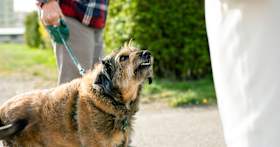
Sometimes when a dog gets frustrated, they can become mouthy or even bite. Biting due to frustration is most commonly seen with leash or barrier reactivity. When a dog is highly aroused or excited, such as when they see another dog, person, or stimulus they can’t get to, they can become overwhelmed and redirect that energy onto whatever is nearby, including a person or another animal. This often happens when a dog is restrained by a leash, fence, crate, or other barrier.
If the behavior is not addressed through training and the dog is not given an outlet to appropriately express their desires, this frustration can escalate into biting behavior over time.
Sometimes, what seems like a bite is actually part of a dog’s natural play behavior, particularly for puppies and young dogs. Dogs often use their mouths to explore and interact with the world around them leading to nipping, mouthing, or gentle biting during play.
Although this is normal for puppies, it can become a problem if the dog doesn’t learn proper bite inhibition or if play becomes overly rough or stimulating. Without guidance, a playful nip can escalate into harder biting, especially if the dog gets too excited or doesn’t understand boundaries. Teaching dogs appropriate play, when to take breaks, and how to redirect rough mouthing helps prevent these playful behaviors from turning into real bite risks.
Training that unintentionally encourages aggressive behavior can significantly increase the risk of dog bites. For instance, when dogs are punished for exhibiting warning signs, such as growling, they may be inadvertently taught to respond with more aggression.
Alternatively, if they are allowed to play too roughly without boundaries, they may learn that biting gets results. Inconsistent rules, lack of impulse-control training, and reinforcement of pushy or rude behavior can all contribute to a dog using their mouth inappropriately. Positive, consistent training and clear communication are key to teaching dogs appropriate responses to everyday situations, even when they are feeling distressed.

Vivian Zottola, MSc, CBCC, has all the answers (not to mention helpful dog-training tips) to transform your unhappy pooch into a calm, content dog.
You can’t train away biting without understanding why it’s happening. From pain to fear to stress, the reasons vary — and so does the training approach. Here’s how to start figuring out why your dog is biting and get the right kind of help. Most dogs who bite can improve with proper training and, in some cases, medical treatment.
Check for medical issues: The first step in addressing biting behavior is to rule out any underlying pain or illness, especially if the bite seemingly came out of nowhere and this isn’t a behavior your dog has exhibited before.
Identify triggers: If pain and illness have been addressed, the next step is to identify why your dog is biting and the severity of the bite(s) — with the goal of preventing this from happening again. It’s important to remember that the more times a dog bites, the more likely it is to happen again. Once you identify the trigger, you can work with a pro to help your dog find better outlets for their discomfort.
Seek help from a trainer: If you’re unsure how to identify the reasons behind your dog’s biting or how to handle them appropriately, seek help from a positive reinforcement trainer experienced with your dog’s bite level. Most importantly, never punish your dog for growling or showing other warning signs. Punishing these signals can teach your dog to skip warnings and escalate directly to biting.
Seek help from a behaviorist: In some cases, working with a veterinary behaviorist may be necessary. These specialists can offer medication that helps reduce anxiety, fear, or impulsivity, making it easier for your dog to focus, learn, and respond positively to training.
Seek help from a vet: Medication can be a valuable tool to support your dog’s emotional well-being as behavior modification takes place. It’s important to note that medication is best used in conjunction with behavior modification to give your dog the best chance at success. Medication alone is not a permanent fix.
Rehoming a dog with a history of biting can be a difficult process. If you decide that your dog isn’t the right fit for your family, home, or lifestyle, it’s important to approach rehoming with honesty and transparency, especially regarding any past bite incidents.
Being honest with potential adopters or rescue organizations is crucial, because withholding this information is both irresponsible and can result in legal consequences. In many states, such as California, a dog’s bite history must be disclosed prior to adoption. So, how can you responsibly find a new home for a dog with a bite history?
When rehoming a dog who has bitten, carefully screening potential adopters is essential to ensure the dog’s safety and well-being, as well as that of the new family. Look for individuals or households with experience handling dogs with behavioral challenges, especially those knowledgeable about bite prevention and positive reinforcement training.
Sometimes rehoming a dog with a bite history can be as simple as finding them a home where that trigger is not around. For example, if your dog only has a bite history with other dogs, a home where your dog can thrive as the only dog may be a really good fit. Thorough communication about the dog’s history and needs helps create a successful, safe placement for everyone involved.
Local shelters and rescue organizations can provide valuable support and resources when rehoming a dog. Many of these groups have experience working with dogs who have behavioral challenges and can help find an experienced, skilled adopter or offer guidance on navigating the rehoming process for the best outcome.
Surrendering your dog may be an option, but being transparent about the dog’s bite history allows shelters to make informed decisions and ensures that the dog receives the care and environment they need in a new home.
Some rescues specialize in working with dogs who have behavioral issues. These organizations often have the experience, resources, and training connections needed to safely evaluate and place dogs with bite histories.
They may also have foster homes familiar with managing fear, anxiety, or reactivity, which can give the dog a better chance at long-term success. Share your dog’s history with the rescue, so they can determine if (and how) they can help.
Whether or not a rescue will take a dog with a bite history depends on several factors.
Severity of the bite: A minor nip that doesn’t break the skin may be more acceptable than a deep, seemingly unprovoked bite.
Cause of the bite: Rescues are more likely to help if the bite was clearly fear-based, due to pain, or a one-time incident rather than ongoing, unpredictable aggression.
Resources: Some rescues, especially those with behavior-focused programs or experienced fosters, can work with dogs who have bite histories. However, others, particularly smaller or underfunded groups, may not have that capacity.
Level of transparency: Rescues will only consider accepting the dog if you’re fully honest about their bite history. Withholding information can put people and other animals at risk and may result in the dog being euthanized after placement.
The best type of dog training for dogs who bite is positive reinforcement-based behavior modification, ideally guided by a qualified professional. Qualified professionals include those certified through CPDT, IAABC, and ACVB who specialize in aggression cases and use only force-free, humane methods. Avoid aversive methods, such as shock collars, prong collars, leash pops, or dominance-based techniques. These can increase fear, stress, and the likelihood of biting.
What to do with a dog who bites people depends on why the dog is biting, how severe the bite is, and how often it's happened. You should prioritize safety by managing the environment and supervising all interactions, as well as ruling out any medical issues or pain. It’s important to identify the cause before working towards a solution. Work with a qualified professional, and if the dog is truly not a safe fit for your home and you’ve explored training options, consider rehoming responsibly.
Assis, Luciana S. de, Raquel Matos, Thomas W. Pike, Oliver H. Burman, and Daniel S. Mills. “Developing Diagnostic Frameworks in Veterinary Behavioral Medicine: Disambiguating Separation Related Problems in Dogs.” Frontiers in Veterinary Science 6 (January 17, 2020). doi.org/10.3389/fvets.2019.00499.
Catalán, Alfredo I., Claudia A. Rojas, and Gonzalo A. Chávez. “Recognition of Aggressive and Anxious Behaviors in Canines by a Group of Chilean Veterinarians.” Journal of Veterinary Behavior 38 (July 2020): 8–13. doi.org/10.1016/j.jveb.2020.05.001.
Ciribassi, John. “Resource Guarding in Dogs (Proceedings).” DVM 360, August 1, 2011. www.dvm360.com/view/resource-guarding-dogs-proceedings.
Dunbar, Ian. “How to Objectively Assess the Severity of Dog Bites.” DunbarAcademy.com. Accessed July 14, 2025. www.dunbaracademy.com/pages/dadd-bite-scale.
Ingeo, Serenella d’, Fabrizio Iarussi, Valentina De Monte, Marcello Siniscalchi, Michele Minunno, and Angelo Quaranta. “Emotions and Dog Bites: Could Predatory Attacks Be Triggered by Emotional States?” Animals 11, no. 10 (October 8, 2021): 2907. doi.org/10.3390/ani11102907.
Jacobs, Jacquelyn A., Jason B. Coe, David L. Pearl, Tina M. Widowski, and Lee Niel. “Factors Associated with Canine Resource Guarding Behaviour in the Presence of Dogs: A Cross-Sectional Survey of Dog Owners.” Preventive Veterinary Medicine 161 (December 2018): 134–42. doi.org/10.1016/j.prevetmed.2017.02.004.
Landsberg, Gary M, and Sagi Denenberg. “Behavioral Problems of Dogs - Behavior.” Merck Veterinary Manual, April 2025. www.merckvetmanual.com/behavior/normal-social-behavior-and-behavioral-problems-of-domestic-animals/behavioral-problems-of-dogs.
Madson, Cathy. “Resource Guarding in Dogs: What to Do and Not Do.” Preventive Vet, July 28, 2020. www.preventivevet.com/dogs/resource-guarding-in-dogs.
McGuire, Betty. “Characteristics and Adoption Success of Shelter Dogs Assessed as Resource Guarders.” Animals 9, no. 11 (November 17, 2019): 982. doi.org/10.3390/ani9110982.
McPeake, Kevin J., Lisa M. Collins, Helen Zulch, and Daniel S. Mills. “The Canine Frustration Questionnaire—Development of a New Psychometric Tool for Measuring Frustration in Domestic Dogs (Canis Familiaris).” Frontiers in Veterinary Science 6 (May 17, 2019). doi.org/10.3389/fvets.2019.00152.
Robins, Mary. “What Makes Dogs Act Aggressive? New Research Offers More Info.” American Kennel Club, January 18, 2022. www.akc.org/expert-advice/training/study-uncovers-factors-behind-dog-aggression.
Salonen, Milla, Sini Sulkama, Salla Mikkola, Jenni Puurunen, Emma Hakanen, Katriina Tiira, César Araujo, and Hannes Lohi. “Prevalence, Comorbidity, and Breed Differences in Canine Anxiety in 13,700 Finnish Pet Dogs.” Scientific Reports 10, no. 1 (March 5, 2020). doi.org/10.1038/s41598-020-59837-z.
Sung, Wailani. “Fear Aggression in Dogs.” PetMD, March 14, 2023. https://www.petmd.com/dog/behavior/fear-aggression-dogs.Sung, Wailani. “Fear Aggression in Dogs.” PetMD, March 14, 2023. www.petmd.com/dog/behavior/fear-aggression-dogs.
Waite, Mindy, and Tiffany Kodak. “Owner-Implemented Functional Analyses and Reinforcement-Based Treatments for Mouthing in Dogs.” Behavior Analysis in Practice 15, no. 1 (April 6, 2021): 269–83. doi.org/10.1007/s40617-021-00554-y.

Mia is a Certified Professional Dog Trainer and Behavior Consultant with a deep passion for helping dogs and their families build positive, lasting relationships. As the owner and trainer of Ace’s Pace based out of Sacramento, CA, she focuses on fear-free, science-backed techniques to guide pet parents through the nuances of dog behavior, training, and enrichment. Through a gentle, positive approach rooted in understanding and trust, Mia strives to help every dog live their best life, with the support and guidance that pet parents need to be successful. You can follow Mia and her life with dogs on Instagram at aces.pace.sacramento.

Rehome

Behavior & Training

Behavior & Training

Behavior & Training

Behavior & Training

Behavior & Training

Behavior & Training
Behavior & Training
Behavior & Training


Rehome
If you’re considering finding a new home for a pet, check out Rehome. It’s Adopt a Pet’s safe, simple program that lets people safely rehome a pet.

Rehome

Rehome
By rehoming your dog directly, you might help open up space for other animals who might be in more urgent need of shelter.